Accession Data:
Amorphophallus titanum (Becc.) Becc. ex Arcang.
- Common Name: Titan Arum, Corpse Flower, Bunga Bangkai
- Family: Araceae Juss.
- Country of Origin: Sumatra
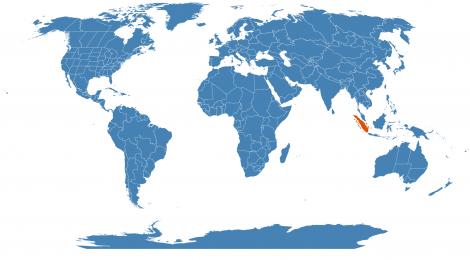
- Habitat: equatorial rainforests on limestone hills
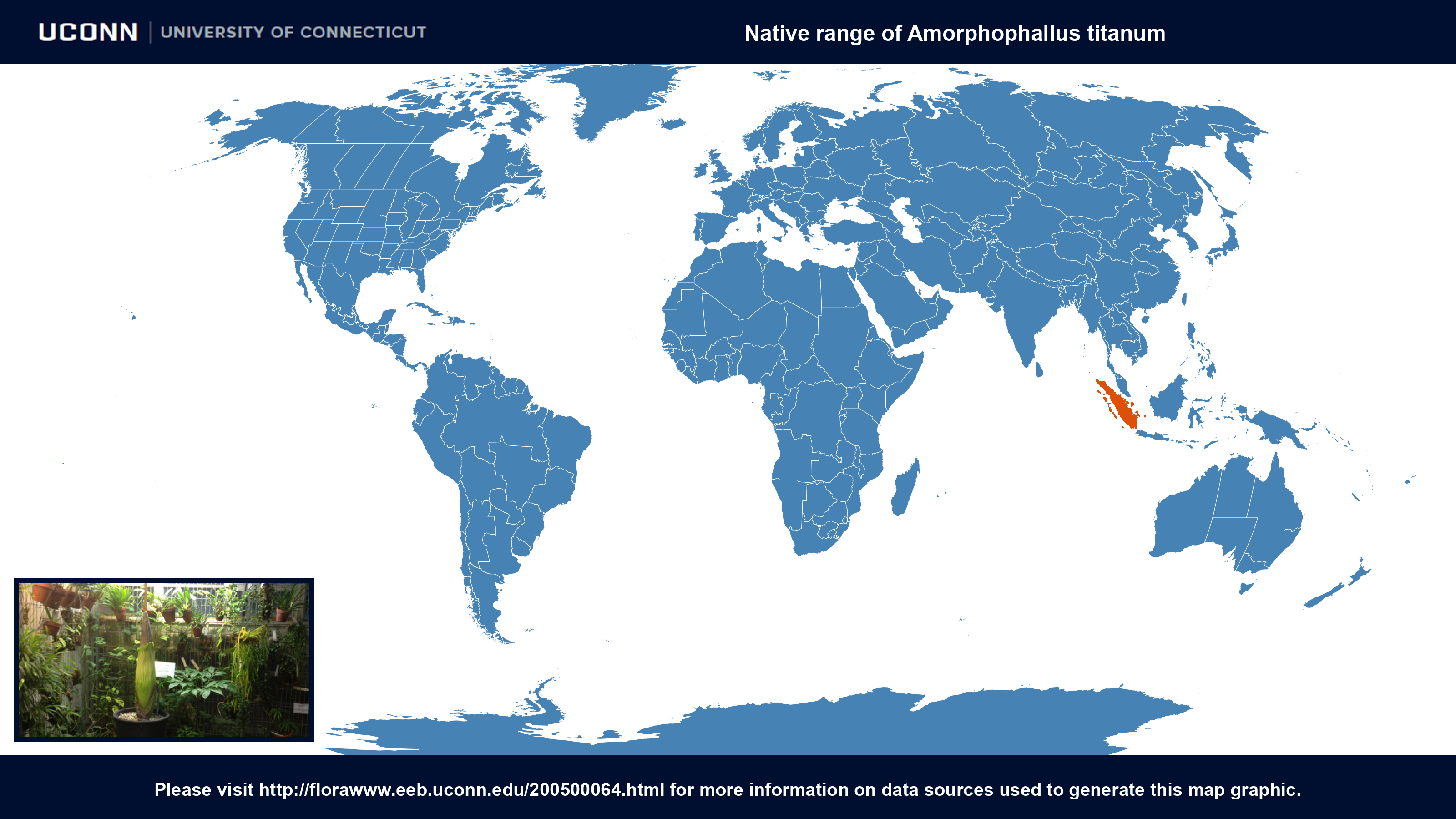
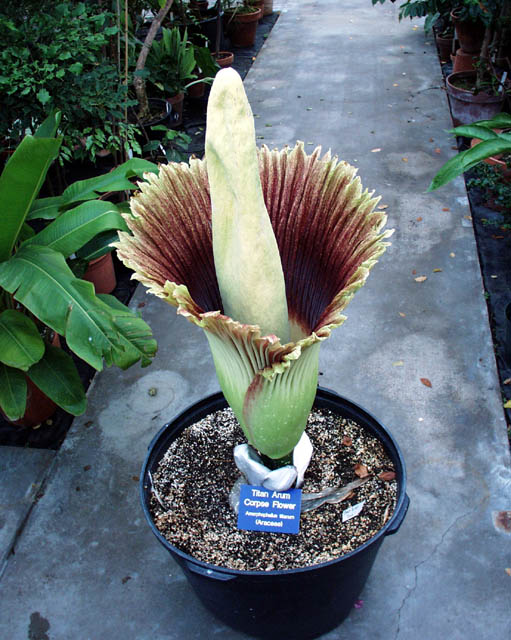
- Description: Amorphophallus titanum, the titan arum, is a cormous plant endemic to western Sumatra, where it grows in openings in rainforest on limestone hills. Locals know it by the more evocative name 'corpse flower' (bunga bangkai), because of the hideous stench the fly-pollinated inflorescences produce.
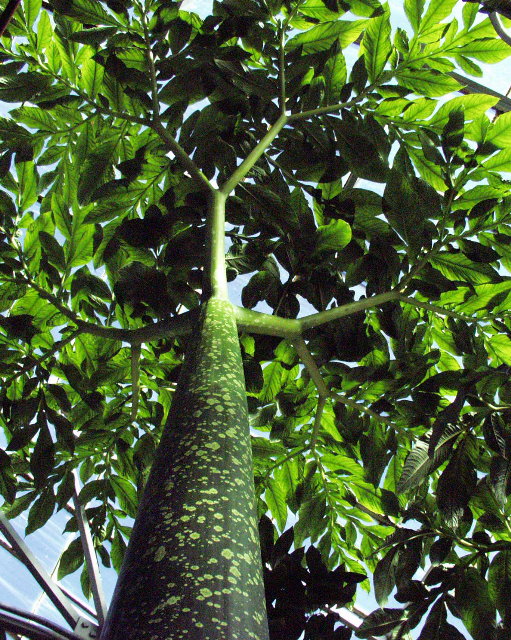
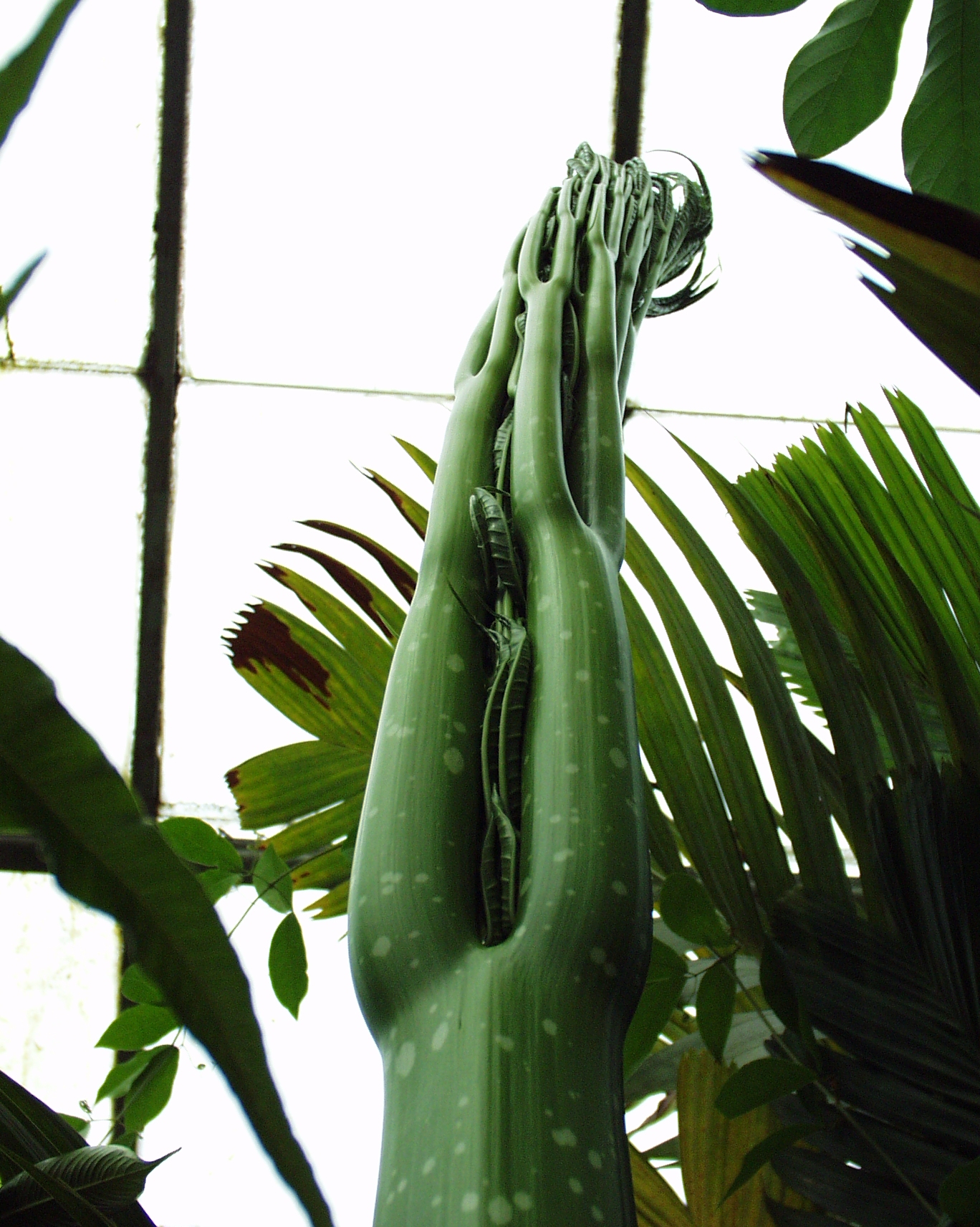
Mature corms of A. titanum typically weigh between 25 and 50 kg, with weights up to 75 kg recorded. Corms produce solitary, highly dissected leaves over 3 m high and 4 m across. Leaves persist for ca. 1-2 years. The plant enters a dormant phase of several months after a leaf senesces, before sending up a replacement leaf and growing a new root system. Leaves are hysteranthous: flowers are borne by otherwise dormant plants. The timing of dormancy and growth phases seems to be more or less random with respect to the seasons; wild populations are reported to have plants in various stages of growth at any given time. It is unclear why the plants ever go dormant at all, given their equatorial habitat.
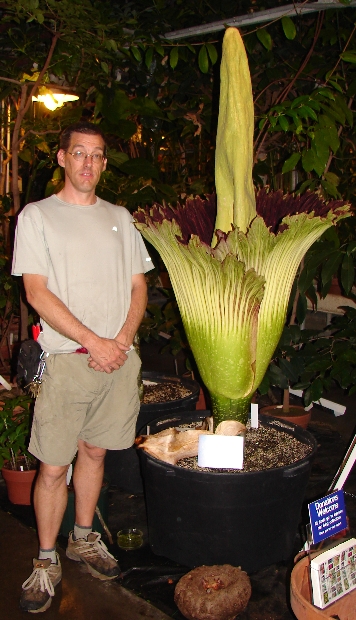
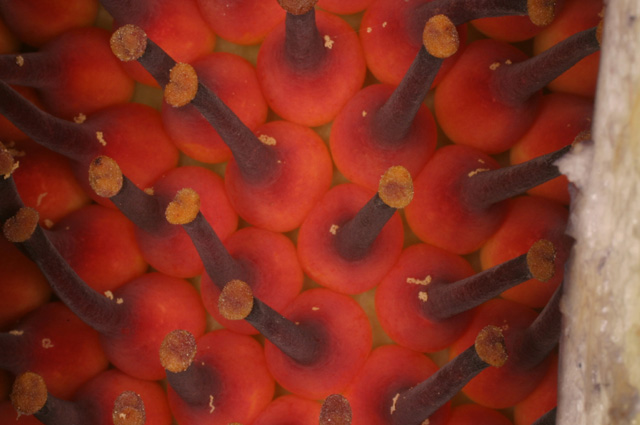
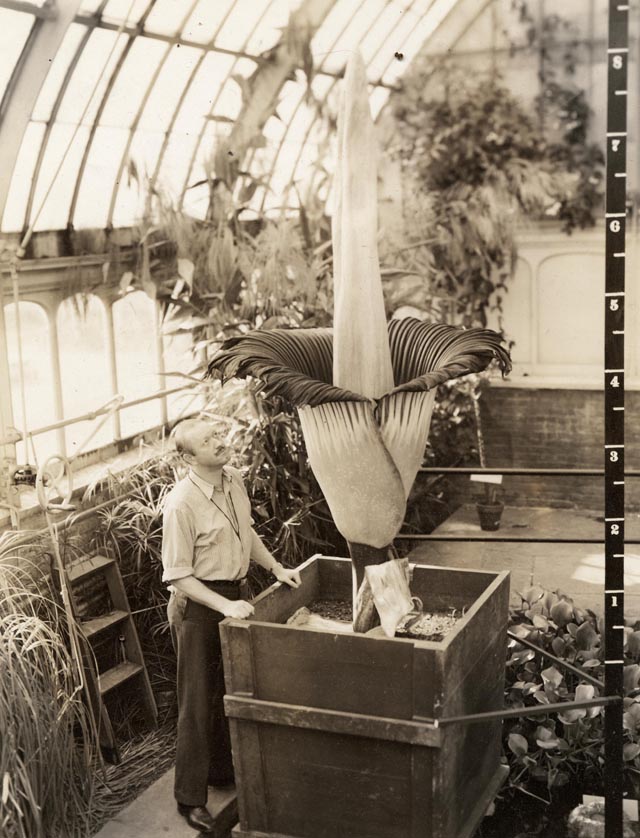
Flower buds emerge shortly after corms become dormant, and are accompanied by the development of a limited root system, unlike the flowers of temperate Amorphophallus species. Inflorescences consist of a fluted spathe (petal-like leaf) with a meat-like purple interior, and a sickly-yellow spadix (central stem bearing many small male and female flowers). While technically not single flowers, the inflorescences of A. titanum are the largest flower-like structures in the plant kingdom, often reaching 2 m high and 1 m in diameter, or larger. While open, the spadix warms itself with metabolic heat, in what is perhaps an adaptation to volatilize and disperse its carrion-insect-attracting odor. The putrid smell of the corpse flower is strongest just after the spathe unfurls, late at night, suggesting pollination by nocturnal flies and beetles.
The following YouTube video features our 2011 bloom and was produced for us by UConn Today:
- Culture: Corpse flowers require warm temperatures, high humidity, and bright light, with some shade in summer. Plants appreciate fairly heavy fertilization. The soil should be kept moist at all times, even during dormancy. Propagation is apparently possible with leaf and tuber cuttings, though we have not had much luck.
Accession Data:
- Accession # 200500064
- Source: Barron Rugge - UCSB
- Provenance:
2nd Generation seedlings - maternal parent was one of original UConn plants from accession 199500115 given to UCSB at AERGC meeting in 1995.
This plant was named 'Tiny' at UCSB and bloomed 15AUG2002 and seed was collected 03MAR2003 and planted 05MAY2003.
'Tiny' was pollinated with pollen from the Huntington Botanic Gardens.
- Accession Date: 08-22-2005
- Bench: 3203 - DORMANT:South
- Currently: deceased
- Qty: 0 confirmed on 03-02-2023
Classification:
- Division: Magnoliophyta
- Class: Liliopsida
- SubClass: monocots
- Order: Alismatales
- SubOrder:
- Family: Araceae
- SubFamily: Aroideae
- Tribe: Thomsonieae
- SubTribe:
Flowering Data:
This accession has been observed in bloom on:| Year | Jan | Feb | Mar | Apr | May | Jun | Jul | Aug | Sep | Oct | Nov | Dec | ||||||||||||||||||||||||||||||||||||||||
|---|---|---|---|---|---|---|---|---|---|---|---|---|---|---|---|---|---|---|---|---|---|---|---|---|---|---|---|---|---|---|---|---|---|---|---|---|---|---|---|---|---|---|---|---|---|---|---|---|---|---|---|---|
| 2024 | ||||||||||||||||||||||||||||||||||||||||||||||||||||
| 2023 | ||||||||||||||||||||||||||||||||||||||||||||||||||||
| 2022 | ||||||||||||||||||||||||||||||||||||||||||||||||||||
| 2021 | ||||||||||||||||||||||||||||||||||||||||||||||||||||
| 2020 | ||||||||||||||||||||||||||||||||||||||||||||||||||||
| 2019 | ||||||||||||||||||||||||||||||||||||||||||||||||||||
| 2018 | ||||||||||||||||||||||||||||||||||||||||||||||||||||
| 2017 | ||||||||||||||||||||||||||||||||||||||||||||||||||||
| 2016 | ||||||||||||||||||||||||||||||||||||||||||||||||||||
| 2015 | ||||||||||||||||||||||||||||||||||||||||||||||||||||
| 2014 | ||||||||||||||||||||||||||||||||||||||||||||||||||||
| 2013 | ||||||||||||||||||||||||||||||||||||||||||||||||||||
References (internal):
- EEB Greenhouse Holdings native to: Sumatera
References (external):
- Hortus Third, LH Bailey Hortorium, 1976 Bown, D. 1988.
- Aroids: Plants of the Arum Family. Timber Press, Portland, Or. Pickrell, J. 2003.
- Researchers uncover secrets of gigantic "corpse flower" http://news.nationalgeographic.com/news/2003/07/07 18_030718_stinkyflower.html
- Lobin, W., Neumann, M., Radscheit, M. & W. Barthlott (2007): The cultivation of Titan Arum (Amorphophallus titanum) – A flagship species for Botanic Gardens. Sibbaldia 5: 69-86. Last accessed on Thursday, September 08, 2016.
data regenerated on Sun, 07 Apr 2024 15:30:31 -0400 [bcm v4.0]
Images:
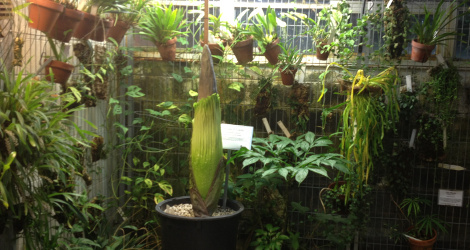
Additional images for this accession:
Click on thumbnails to enlarge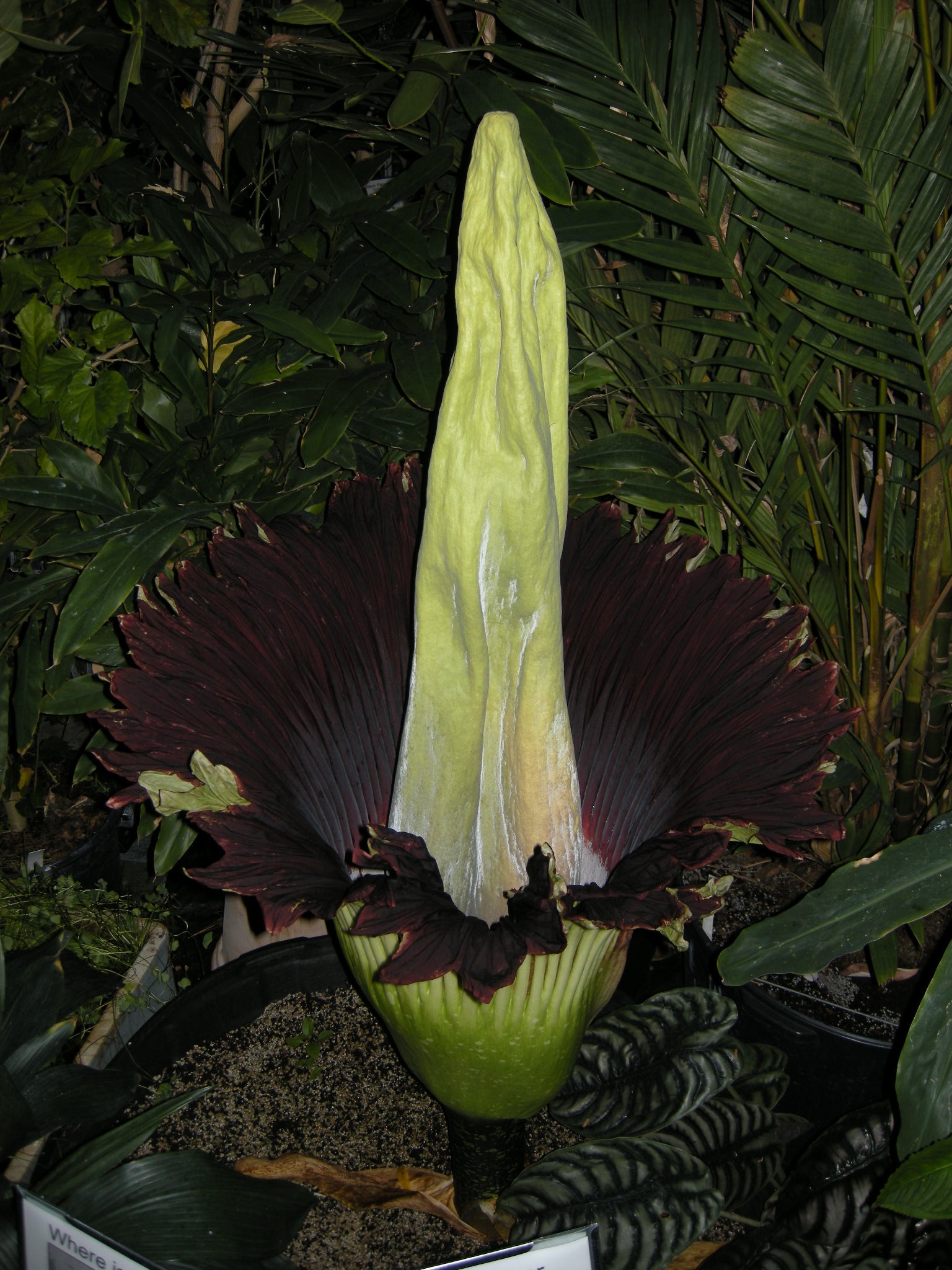
Current Accessions in the Araceae
Subfamily Aroideae
Subfamily Aroideae
Tribe Areae
Subfamily Aroideae
Tribe Caladieae
Subfamily Aroideae
Tribe Colocasieae
- Alocasia Amazonica

- Alocasia cuprea

- Alocasia melo
- Alocasia Micholitziana
- Colocasia affinis
- Colocasia esculenta
- Colocasia fallax
- Colocasia gigantea cv. Thailand Giant
- Remusatia vivipara
Subfamily Aroideae
Tribe Culcasieae
Subfamily Aroideae
Tribe Dieffenbachieae
Subfamily Aroideae
Tribe Philodendreae
- Philodendron angustisectum
- Philodendron atabapoense
- Philodendron bipinnatifidum
- Philodendron brandtianum
- Philodendron crassinervium
- Philodendron grazielae
- Philodendron hederaceum var. oxycardium
- Philodendron imbe
- Philodendron joepii
- Philodendron ornatum
- Philodendron panduriforme
- Philodendron patriciae W/C
- Philodendron pedatum
- Philodendron tripartitum
- Philodendron verrucosum
Subfamily Aroideae
Tribe Pisteae
Subfamily Aroideae
Tribe Spathicarpeae
Subfamily Aroideae
Tribe Thomsonieae
- Amorphophallus albus
- Amorphophallus bulbifer
- Amorphophallus dunnii
- Amorphophallus henryi


- Amorphophallus impressus
- Amorphophallus konjac
- Amorphophallus muelleri
- Amorphophallus paeoniifolius
- Amorphophallus prainii
- Amorphophallus pygmaeus W/C
- Amorphophallus titanum
- Amorphophallus titanum W/C
- Amorphophallus titanum
- Amorphophallus titanum
- Amorphophallus titanum
- Amorphophallus variabilis
- Amorphophallus yunnanensis
- Amorphophallus yunnanensis
Subfamily Aroideae
Tribe Zantedeschieae
Subfamily Lasioideae
Subfamily Lemnoideae
Subfamily Monsteroideae
Tribe Monstereae
- Epipremnum falcifolia
- Epipremnum pinnatum
- Monstera adansonii
- Monstera deliciosa
- Monstera dubia
- Monstera siltepecana
- Monstera subpinnata
- Rhaphidophora cryptantha
- Rhaphidophora decursiva
- Rhaphidophora korthalsii
- Rhaphidophora sulcata
- Scindapsus pictus
- Scindapsus pictus 'Exotica'
- Stenospermation sp.
Subfamily Monsteroideae
Tribe Spathiphylleae
Subfamily Pothoideae
Tribe Anthurieae
- Anthurium andraeanum
- Anthurium bakeri
- Anthurium clarinervium
- Anthurium crystallinum
- Anthurium cubense
- Anthurium forgetii
- Anthurium forgetii
- Anthurium friedrichsthalii
- Anthurium gracile
- Anthurium pedatoradiatum
- Anthurium pendens
- Anthurium pentaphyllum var. bombacifolium
- Anthurium podophyllum W/C
- Anthurium pseudospectabile W/C
- Anthurium scandens
- Anthurium schlechtendalii
- Anthurium veitchii
- Anthurium wendlingeri
Subfamily Pothoideae
Tribe Potheae
Subfamily Zamioculcadoideae
W/C = Wild Collected = indicates flowering in past 14 days
= images available for this accession
= map available for this accession
= indicates flowering in past 14 days
= images available for this accession
= map available for this accession
 = accession added within past 90 days